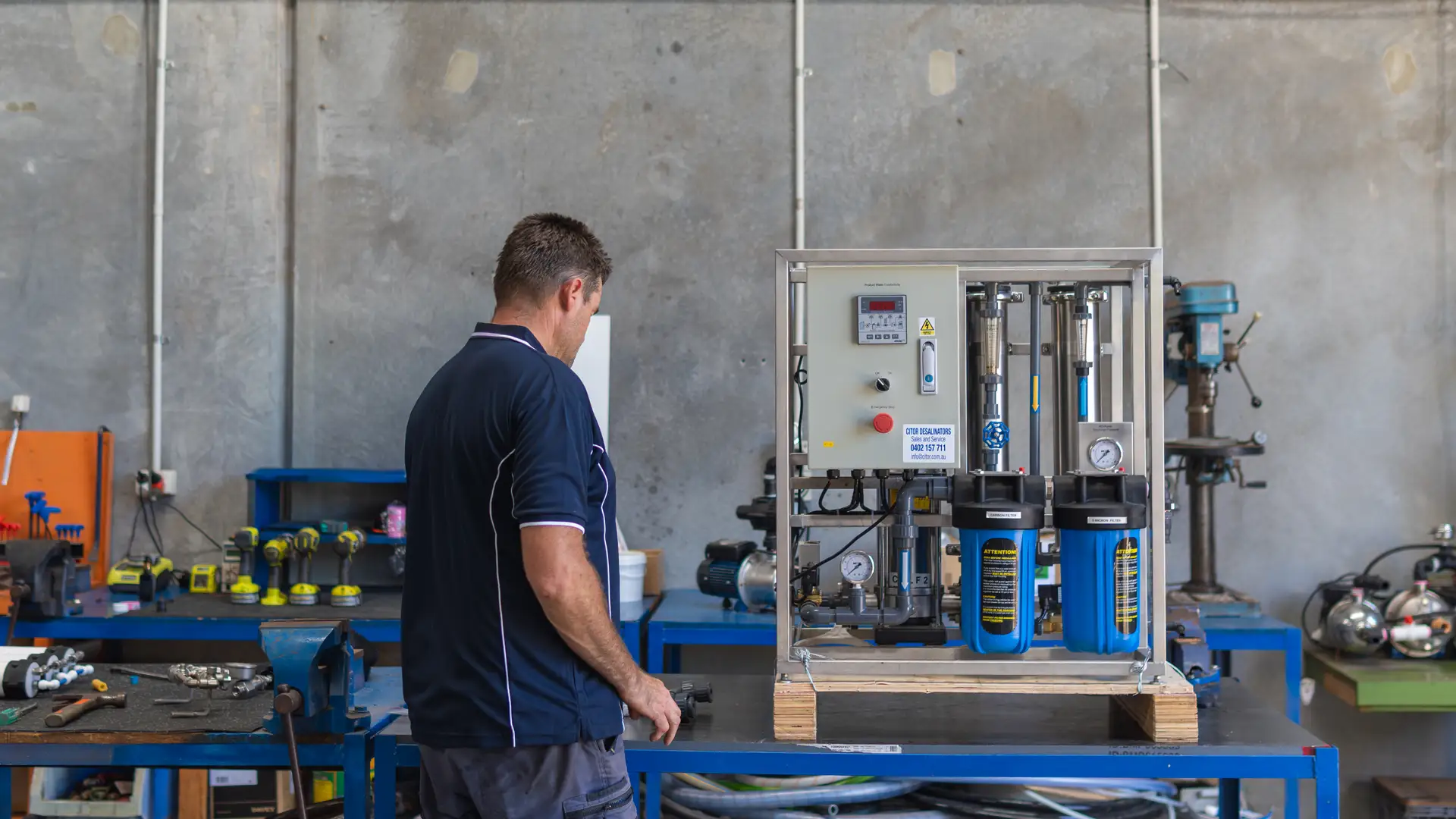
Reverse Osmosis Spare Parts
If you can't see the part you need - please call us on 0402 157 711, or complete the order form below.
Can't see the parts you need?
Ask us for a custom order.
We stock an extensive inventory of parts - if you can't see what you need please contact us. If it's not already on hand we can custom order to match your exact requirements.
Order Request Form
To place an order for spare parts, please complete our order request form below. Once we have your details we will be in touch to finalise your order.
If your order is urgent, please contact our office on 0402 157 711 and speak with one of our staff members.
FAQs
Answers to common questions about maintenance, servicing, spare parts and ongoing support for your CITOR system.
Chemical use in reverse osmosis systems is minimal but important for optimal performance:
Anti-Scalant Dosing:
Prevents precipitation of calcium carbonate, calcium sulfate, barium sulfate, and other minerals that can form scale on membrane surfaces. Anti-scalant is continuously dosed at very low concentrations (typically 2–5 PPM) into feed water before the RO membranes.
pH Adjustment:
Occasionally required to optimise membrane performance or prevent scale formation. Achieved through acid dosing (sulfuric acid, hydrochloric acid) or alkaline dosing (sodium hydroxide, lime).
Chlorine/Oxidant Removal:
Membranes are damaged by chlorine and oxidising agents. If present in source water (municipal supplies, surface water treatment), removal through activated carbon filtration or other methods is required.
Membrane Cleaner (1 kg supplied with each system):
Citric Acid for removing organic fouling, biological growth, and general accumulation.
Membrane Sterilizer (1 kg supplied with each system):
Sodium Metabisulphite for removing mineral scaling and inorganic deposits. Also has biocidal properties.
Cleaning frequency depends on source water quality and operating conditions. Performance monitoring indicates when cleaning is necessary (increased operating pressure, decreased product water quality, reduced production rate).
Disinfection:
UV sterilisation (no chemicals) or chlorination (minimal dosing) may be used as final treatment stage depending on distribution system and local regulations.
CITOR provides specification for all required chemicals, recommended suppliers, and handling procedures with each system.
Membrane service life varies significantly based on source water quality and maintenance practices:
- Well-maintained systems with good source water: 4–7 years
- Average conditions with proper maintenance: 3–5 years
- Challenging chemistry or inadequate maintenance: 1–3 years
Membrane performance gradually declines over time. Replacement is indicated when product water quality degrades below acceptable levels or when required operating pressure increases significantly to maintain output.
Proper maintenance ensures long-term reliability and consistent performance. CITOR systems are designed for straightforward maintenance by operators without specialised training. Please note that in practice, maintenance schedules differ — they are primarily dependent on hours of use and the environment in which the equipment is operating. Below is a guide to a top tier maintenance schedule.
Daily Operations:
- Visual inspection of operating parameters (pressure, flow rate, salinity)
- Verification of automatic fresh water flushing cycles
- General observation for leaks or unusual operation
Weekly Maintenance:
- Clean pre-filters or replace filter cartridges (depending on source water quality)
- Inspect and clean intake screens (seawater applications)
- Record operating parameters for trend monitoring
Monthly Maintenance:
- Detailed inspection of all system components
- Check and adjust chemical dosing systems (if fitted)
- Inspect pump seals and mechanical components
- Review recorded data and performance trends
Quarterly or Semi-Annual Maintenance:
- Clean RO membranes using specified cleaning procedures (if applicable)
- Service pumps according to manufacturer recommendations
- Comprehensive system inspection and testing
Annual or Biennial Maintenance:
- Major component servicing or replacement based on wear
- Complete system performance evaluation
- Seasonal preventative maintenance and component replacement if required
- Pressure vessel inspection (if required by certification)
CITOR provides comprehensive after-sales support ensuring long-term system reliability:
- Immediate post-installation performance monitoring and operator support
- Ongoing technical support via phone and email
- Preventive maintenance programs (client-performed or contracted)
- Spare parts availability with rapid dispatch
- System upgrades and modifications as requirements change
- Long-term engineering support throughout system life
Relationship continues well beyond installation—CITOR maintains technical documentation and support for systems decades old.
12-Month Manufacturing Warranty covering manufacturing defects in materials and workmanship. Includes frame, pumps, pressure vessels, electrical components, control systems, piping, and fittings. The warranty is subject to commissioning and operation as per CITOR factory requirements.
Written performance data specifies production capacity, product water quality, recovery rate, and operating parameters. Factory testing is performed before dispatch with results documented.